Educational only. This checklist covers general bookkeeping and recordkeeping tasks at the end of a year. It does not list tax filing requirements, deadlines, or forms; ask a tax professional about those.
Short answer
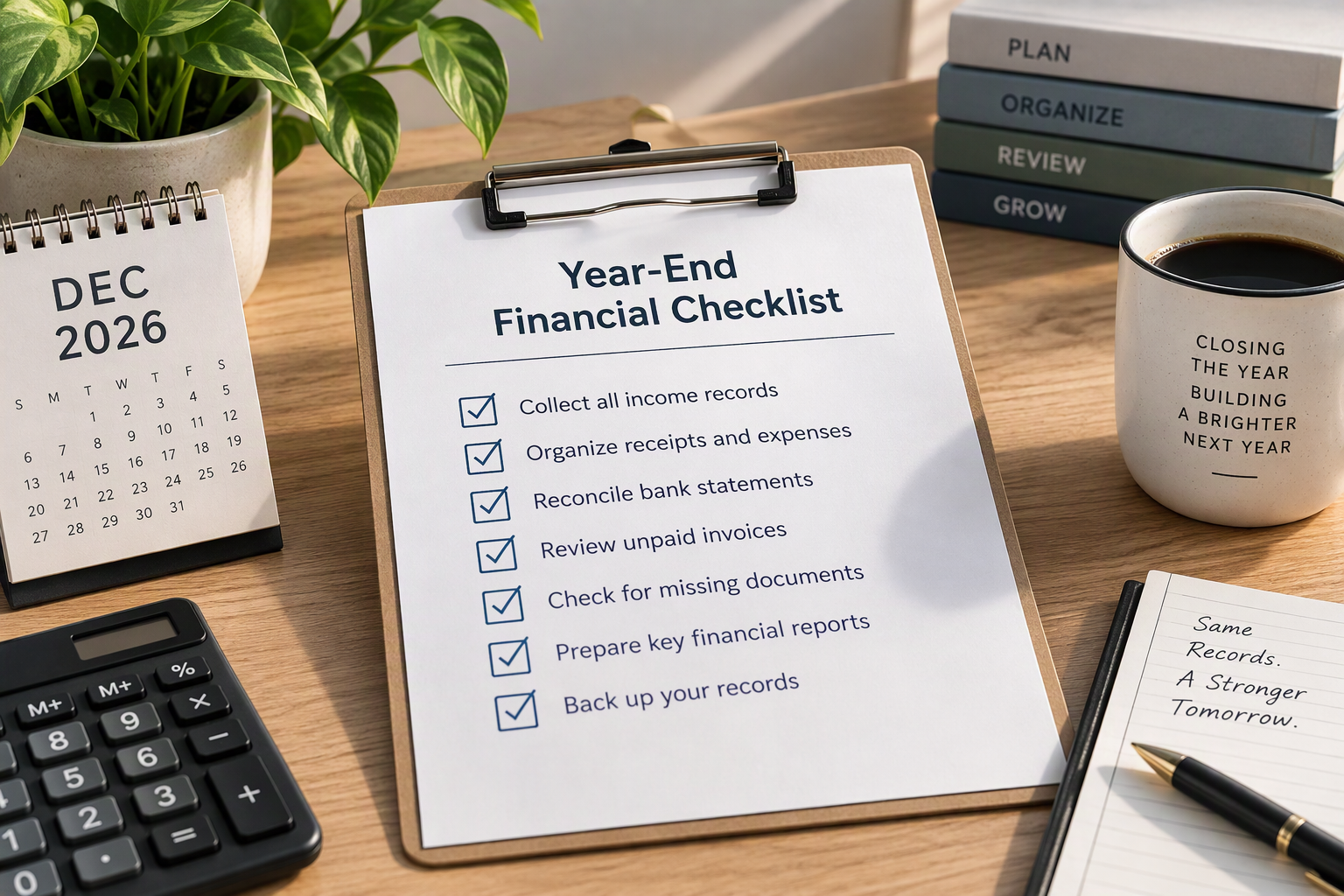
A year-end financial checklist closes the books on the year in five steps: finish the income records, finish the expense records, reconcile every account through December, produce the year’s summary reports, and archive and back up the year. Doing it in January, while the year is fresh, is far easier than doing it the week before a tax appointment.
Before you start
Set aside time in early January and gather:
- December statements for every business bank and card account
- Your invoice list or tracker
- Your expense folders for the year
- Your bookkeeping file or software
- Last year’s checklist, if you have one
Step 1: Income
- Every invoice for the year is in the invoice folder, including void ones
- Every payment received is matched to an invoice
- Unpaid invoices on December 31 are listed with their amounts and due dates
- Old unpaid invoices are reviewed: follow up, or decide with your bookkeeper or accountant how to treat any you do not expect to collect
- Payment platform and app reports for the year are downloaded
The list of unpaid invoices on December 31 is your year-end accounts receivable: money clients still owed you as the year closed. How to organize unpaid invoices shows how to keep that list current all year.
Step 2: Expenses
- Every month’s receipts are filed and named consistently
- Monthly tie-outs are done (receipts against statements)
- Missing receipts are requested or noted
- Personal purchases are out of business expense categories
- Bills received in December but paid in January are noted
How to organize receipts by month and category covers the monthly tie-out.
Step 3: Reconcile every account through December
- Each business checking account reconciled for December
- Each business card account reconciled for December
- Any differences explained and recorded
IRS Publication 583 suggests reconciling your checking account each month and making sure your bank statement, your checkbook, and your books agree. At year-end, the December reconciliation confirms that the year’s records match the bank’s.
Step 4: Summary reports for the year
- Profit and loss statement for the full year
- Profit and loss statement by month or quarter, to see trends
- List of equipment and other assets bought or sold during the year
- Totals of owner’s draws and owner contributions
- A short list of questions for your tax professional
IRS Publication 583 notes that good records are needed to prepare accurate financial statements, such as income (profit and loss) statements and balance sheets, and that these statements can help in dealing with a bank or creditors. How to read a profit and loss statement explains each line of the report.
Step 5: Archive and back up
- Close the year’s folder and create next year’s
- Back up the year’s digital records to a second location and check the backup opens
- Store paper records for the year in one labeled box or folder
- Note where everything is stored
The IRS explains that how long you should keep a document depends on the action, expense, or event it records. It also says that when records are no longer needed for tax purposes, you should check whether others, such as an insurer or creditors, require you to keep them longer. Check the IRS page and ask a tax professional before discarding anything. Digital vs paper business records covers backups.
A fictional example of the year-end summary
Maya Ortiz runs Ortiz Studio. Her one-page year-end summary lists each figure next to the place it comes from:
| Item | Where it comes from |
|---|---|
| Revenue for the year | Sum of invoices issued (in her approach) |
| Expenses by category | Monthly category totals |
| Net profit for the year | Revenue minus expenses |
| Unpaid invoices on Dec 31 | Invoice tracker |
| Owner’s draws for the year | Owner transactions folder |
| Equipment bought | Assets folder |
| Accounts reconciled through December | Reconciliation folder |
The point of the sheet is that every figure has a source in the folders.
Questions to take to your tax professional
Prepare questions rather than answers. For example:
- Which of my records do you need, and in what format?
- How should equipment I bought this year be handled?
- How should I treat invoices I do not expect to be paid?
- Is there anything in my records that looks incomplete?
Common mistakes
- Starting the year-end close the week of a tax appointment.
- Skipping the December reconciliation, so small errors carry into the new year.
- Deleting or overwriting old files when starting the new year.
- No backup of the closed year.
- Correcting old errors silently. If you find a mistake from earlier in the year, record a correction with a note. See How to correct a bookkeeping error without hiding it.
What can vary
- Your business. Payroll, inventory, or vehicles add their own year-end tasks.
- Your tax situation, which determines forms, deadlines, and what your tax professional needs.
- Your fiscal year, if the business does not use the calendar year.
When to ask a professional
Year-end is the most common time to involve one. A bookkeeper can close the books; a tax professional can tell you what the return requires.
Summary
Finish income and expense records, reconcile every account through December, produce the year’s reports, and archive with a tested backup. Then bring organized records and clear questions to whoever prepares your return. For a list of the records themselves, see What financial records should a freelancer keep?.
Sources
- IRS, Publication 583, Starting a Business and Keeping Records. Revised December 2024. Consulted November 17, 2026. Used for: reconcile the checking account each month so the statement, checkbook, and books agree; good records are needed to prepare financial statements, which help in dealing with banks or creditors.
- IRS, How long should I keep records?. Page shows “Last Reviewed or Updated: 30-Jun-2026.” Consulted November 17, 2026. Used for: retention depends on the action, expense, or event; check nontax needs such as insurers or creditors.
The checklist, steps, and example layout are the editorial team’s own.