Educational only. This guide gives a general overview of business records. It does not say which records any particular person must keep for tax purposes or for how long; for that, see the IRS pages listed below or ask a tax professional. Examples are fictional.
Short answer
Most freelancers need five groups of records: what they billed and received, what they spent, their bank and card statements, records of money moving between them and the business, and records of anything valuable the business owns. Add the summaries you build from those records, such as a monthly profit and loss statement, and keep everything organized by year and type.
Why keep records at all
Records are how you answer basic questions about your own business: Who still owes me money? What did I spend on software this year? Did I make a profit in March? IRS Publication 583 notes that good records help you monitor the progress of your business and prepare financial statements, and that those statements can help when dealing with a bank or creditors. Records also back up what you report on a tax return.
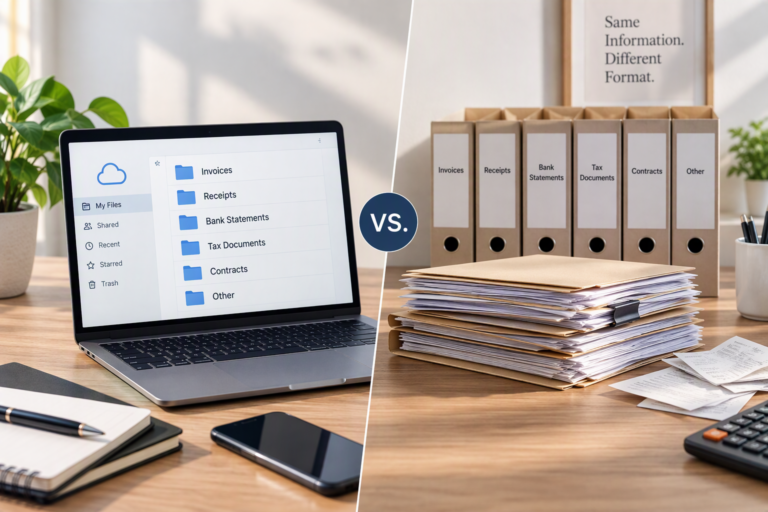
The IRS also notes that, except in a few cases, the law does not require any specific kind of records: you can choose a recordkeeping system suited to your business that clearly shows your income and expenses. The groups below are a practical way to make sure nothing important is missing.
The five groups of records
| Group | Examples | Why it matters |
|---|---|---|
| 1. Income records | Invoices you sent, receipts you gave, payment confirmations, records from payment apps or platforms, deposit records | Show what you billed, what was paid, and what is still owed |
| 2. Expense records | Receipts, bills, vendor invoices, subscription confirmations | Show what you spent and on what |
| 3. Bank and card statements | Monthly statements for every business account and card | The independent record of money in and out |
| 4. Owner transactions | Transfers to yourself, money you put into the business, loans | Separate business results from personal money |
| 5. Asset records | Purchase records for equipment such as computers or cameras, and records when you sell or dispose of them | Show what the business owns and what it cost |
The IRS lists the most common supporting documents as sales slips, paid bills, invoices, receipts, deposit slips, and canceled checks, and says these documents contain the information you need to record in your books. Its page on recordkeeping also notes that, for most small businesses, the business checking account is the main source for entries in the business books.
Records you create from the source documents
Source documents are the raw material. Most businesses also keep a few summaries:
- A simple ledger or bookkeeping file listing each transaction with a date, amount, category, and note.
- An invoice tracker showing which invoices are open, paid, or overdue. See How to organize unpaid invoices.
- Monthly profit and loss statements. See How to read a profit and loss statement.
- Bank reconciliations, the monthly check that your records and the bank statement agree. Publication 583 suggests reconciling your checking account each month.
A fictional example: one month of records
Maya Ortiz runs Ortiz Studio. For April 2026, her records folder holds:
| Record | Count | Notes |
|---|---|---|
| Invoices sent | 3 (OS-016, OS-017, OS-018) | Total $2,300 |
| Payments received | 1 (OS-016, $800) | Matched to its invoice |
| Expense receipts and bills | 7 | Total $700, sorted by category |
| Bank statement | 1 | April statement for the business account |
| Owner’s draw record | 1 | $1,000 transfer to her personal account |
| April profit and loss statement | 1 | Revenue $2,300, expenses $700, net profit $1,600 |
| Bank reconciliation | 1 | Records and statement agree |
Everything is made up for illustration. The point is that each number in the summary can be traced back to a document in the folder.
How long to keep records
The IRS explains that the length of time you should keep a document depends on the action, expense, or event the document records, and it sets out the periods on its page “How long should I keep records?” (linked below). It also notes that when records are no longer needed for tax purposes, you should check whether you need them for other purposes; for example, an insurance company or creditors may require you to keep them longer. Because the rules depend on your situation, this guide does not give a single number. Check the IRS page and ask a tax professional.
A starter checklist
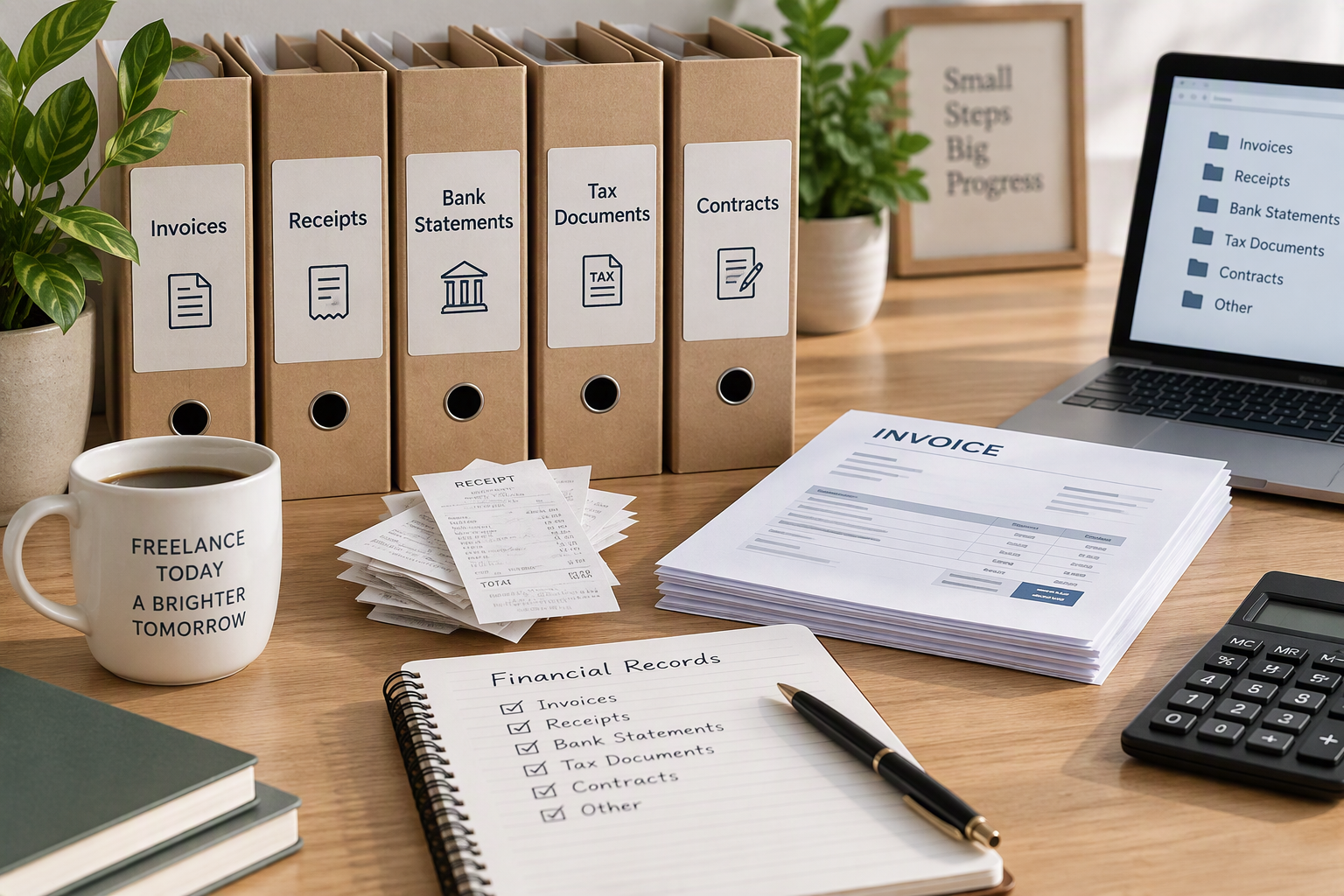
- One folder (paper or digital) per year
- Every invoice you sent, including void ones
- Proof of every payment you received
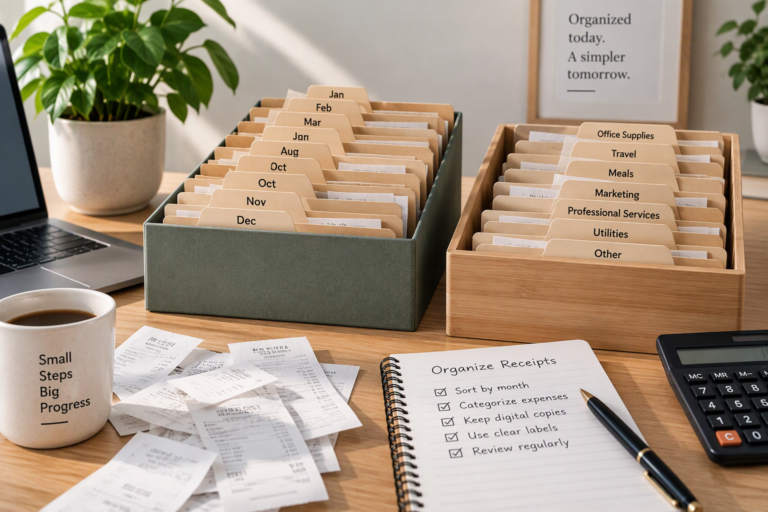
- Receipts and bills for every business expense
- Monthly statements for each business account and card
- Notes for transfers between you and the business
- Purchase records for equipment and other assets
- Monthly summaries: ledger, P&L, reconciliation
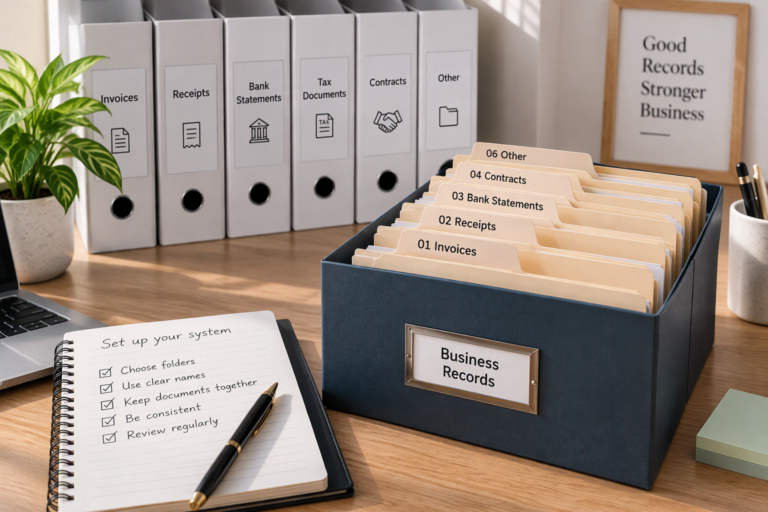
How to create a business records folder system shows one way to lay these out.
Common mistakes
- Keeping statements but not receipts. A statement shows an amount left your account; the receipt shows what you bought.
- Mixing personal and business records in the same folder or account.
- Keeping records only for tax season. Monthly records are what tell you how the business is doing.
- No notes on unusual transactions. Six months later, nobody remembers what “Transfer 0412” was.
What can vary
- Your business. Businesses with employees, inventory, or vehicles keep additional records.
- Who asks. Lenders, insurers, and clients may ask for specific documents.
- Retention periods, which depend on what each record supports.
When to ask a professional
A tax professional can tell you which records support your tax return and how long to keep them. A bookkeeper can help set up a system and catch up a backlog.
Summary
Keep income records, expense records, statements, owner transactions, and asset records, plus the monthly summaries built from them. Organize them by year and type so every number can be traced to a document.
Sources
- IRS, What kind of records should I keep. Page shows “Last Reviewed or Updated: 03-Aug-2026.” Consulted November 17, 2026. Used for: common supporting documents; the information they contain; the business checking account as the main source of entries; organizing by year and type.
- IRS, Publication 583, Starting a Business and Keeping Records. Revised December 2024. Consulted November 17, 2026. Used for: records help monitor progress and prepare financial statements; no specific kind of records required except in a few cases; reconcile the checking account each month.
- IRS, How long should I keep records?. Page shows “Last Reviewed or Updated: 30-Jun-2026.” Consulted November 17, 2026. Used for: retention depends on the action, expense, or event; check nontax needs such as insurers or creditors.
The five-group structure, the example, and the checklist are the editorial team’s own.