Educational only. This guide explains common invoicing conventions. It is not legal or accounting advice. Payment terms are set by the parties, so always read the terms on the invoice or agreement itself. Examples are fictional.
Short answer
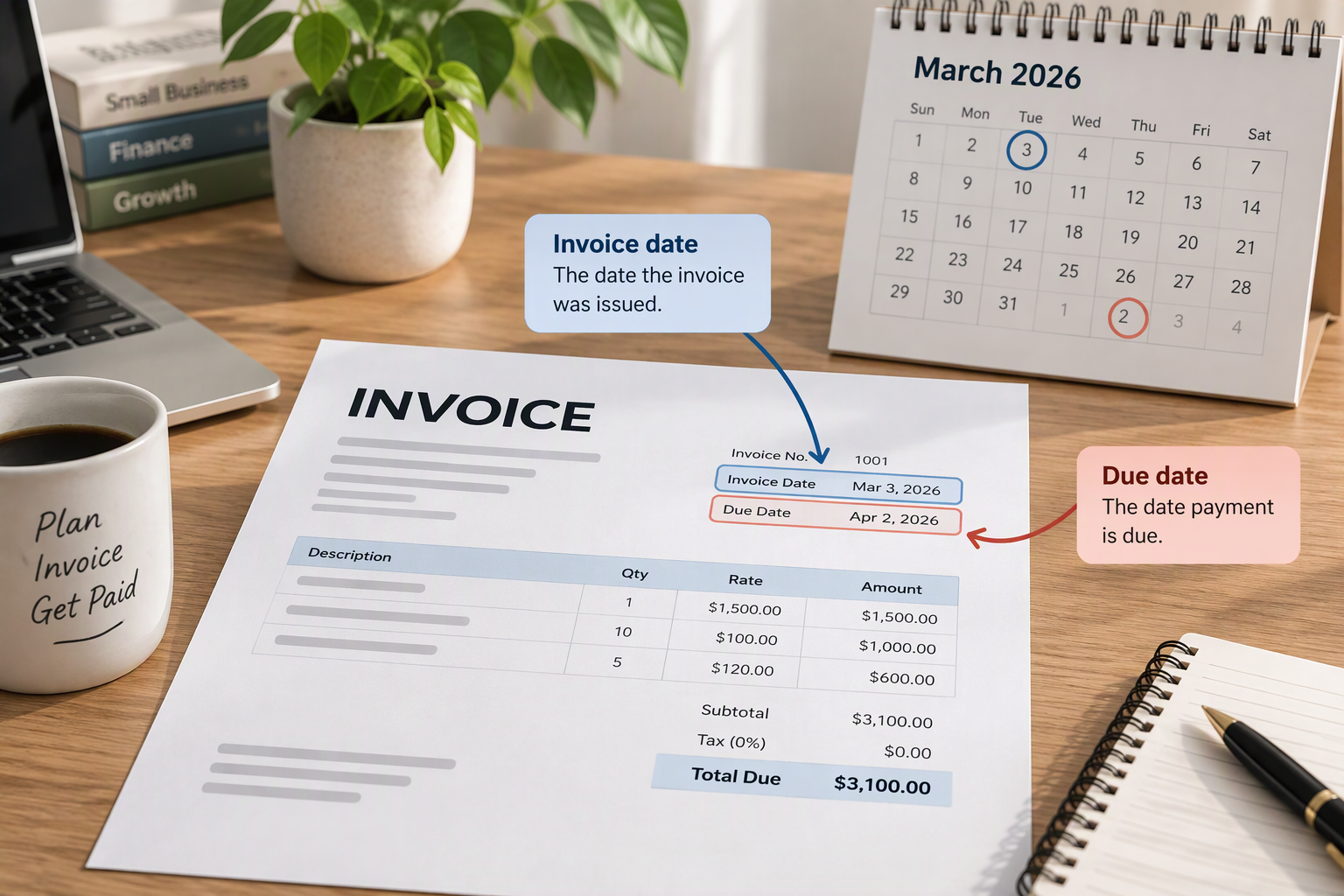
The invoice date is the day the invoice was issued. The due date is the day payment is expected. Payment terms connect the two: with “Net 30,” payment is commonly due 30 days after the invoice date. Writing both dates on the invoice avoids most confusion.
The dates on an invoice
| Date | What it means | Who sets it |
|---|---|---|
| Invoice date | The day the invoice was issued | The seller, when sending the invoice |
| Service or delivery date | When the work was done or the goods were delivered | Recorded by the seller; optional on many invoices |
| Due date | The last day payment is expected under the terms | Follows from the terms, written by the seller |
| Payment date | The day the payment actually arrived | Known only after the client pays |
The invoice date and the service date are often the same day, but not always. A designer might deliver files on the 28th and invoice on the 1st of the next month. Keeping the dates separate makes it clear what each one refers to.
How payment terms turn into a due date
Payment terms are shorthand agreed between seller and client. Common examples in US business:
- Due on receipt: payment is expected when the invoice is received.
- Net 15: payment due within 15 days.
- Net 30: payment due within 30 days.
“Net 30” is general commercial terminology, not a legal or tax rule. A common way to count is to start the day after the invoice date and count calendar days. The terms on your invoice or contract are what count, so if they define the count differently, follow them.
Worked examples
These use fictional invoices from Ortiz Studio, all on Net 30 terms.
| Invoice | Invoice date | Count | Due date |
|---|---|---|---|
| OS-015 | Mar 10, 2026 | 21 days left in March + 9 days in April = 30 | Apr 9, 2026 |
| OS-016 | Apr 1, 2026 | 29 days left in April + 1 day in May = 30 | May 1, 2026 |
| OS-018 | Apr 20, 2026 | 10 days left in April + 20 days in May = 30 | May 20, 2026 |
Months have different lengths, so “the same day next month” is not always 30 days later. Writing the calendar due date on the invoice removes the arithmetic from the client’s side.
Late, on time, or early
Once you know the due date, the payment date tells you where things stand:
| Invoice | Due date | Paid | Result |
|---|---|---|---|
| OS-016 | May 1 | Apr 28 | Paid 3 days early |
| OS-015 | Apr 9 | May 20 | Paid 41 days after the due date |
| OS-018 | May 20 | Not paid by May 31 | 11 days past due on May 31 |
“Days past due” is simply the number of days between the due date and today (or the payment date). It is the number most businesses use to decide when to send a reminder. How to organize unpaid invoices shows how to group open invoices by how long they are overdue.
A sample invoice header
SAMPLE — FICTIONAL DOCUMENT
INVOICE OS-018
Invoice date: Apr 20, 2026
Service completed: Apr 17, 2026
Payment terms: Net 30
Due date: May 20, 2026
SAMPLE — FICTIONAL DOCUMENT. Not a real invoice.
Four lines, no room for misunderstanding.
Common mistakes
- Writing only the terms. “Net 30” without a date invites different counts.
- Backdating or postdating the invoice date to change the due date. Use the real issue date and agree different terms if needed.
- Confusing the service date with the invoice date. Label each one.
- Sending the invoice late. Under “Net 30,” the clock usually starts on the invoice date, so a late invoice means a later payment.
- Not recording the payment date. Without it, you cannot tell whether a client usually pays on time.
What can vary
- How days are counted. Some contracts use business days, end-of-month terms, or a count that starts on delivery. Read the agreement.
- Early-payment discounts and late fees. Some businesses offer or charge them. Whether and how they apply depends on the agreement and the law where you operate; this guide does not cover them.
- Client payment cycles. Some organizations pay invoices on fixed days of the month, whatever the due date.
When to ask a professional
Ask an attorney before adding late fees or interest to your terms. A bookkeeper or accountant can help if you are unsure in which period an invoice belongs in your books.
Summary
The invoice date says when you billed; the due date says when you expect to be paid; the terms connect them. Write all three on the invoice, record the date payment actually arrives, and use the difference to spot late payments early. What is an invoice? covers the rest of the sections.
Sources
This guide relies on common commercial practice and the editorial team’s own worked examples. No official source in this project sets payment terms for private businesses; the terms are agreed between the parties.