Educational only. This article explains common business documents in general terms. It is not tax, legal, accounting, or financial advice, and it does not say what any particular person or business must issue or keep. Every sample document below is fictional.
Short answer
An invoice asks someone to pay. A receipt confirms that a payment was made. A bill is usually an invoice seen from the other side: the document you receive when you are the one who owes money.
One freelance job can produce all three. You send an invoice, the client pays it, and a receipt (or a “paid” confirmation) closes the loop. The details vary by business, client, and industry, so this guide explains the usual pattern and points out where it can differ.
The three documents at a glance
| Detail | Invoice | Receipt | Bill |
|---|---|---|---|
| Who issues it | The seller: the person or business that did the work or supplied the goods | Usually the seller, after receiving the payment | The seller or vendor. The buyer is the one who receives it |
| When it usually appears | Before payment, once the work is done or at a point the two sides agreed on | After payment | Before payment |
| Main purpose | Asks for payment and says what it covers, how much, and by when | Confirms that a payment was received | Tells the person who owes money what to pay and when |
| What it typically shows | Names of both sides, an invoice number, dates, a description of the work, the amount, payment terms | Date paid, amount paid, payment method, what the payment was for, any balance left | Vendor name, what it is for, the amount due, the due date |
| Which side you are on | You are the seller sending it | You are the seller giving it, or the buyer receiving it | You are the buyer receiving it |
| In the sample job below | Invoice OS-014 from Ortiz Studio to Brightleaf Bakery | The payment receipt for invoice OS-014 | The same invoice, as Brightleaf Bakery sees it. Also the Pixelfern Tools subscription bill |
| In the books (your accounting records) | Depends on how the business keeps its books: it may be recorded when sent or only when paid | Helps match a payment to the invoice it settled | Depends on the same choice: recorded when received or when paid |
A simple way to remember the order: invoice (or bill) first, payment next, receipt last.
One job, three documents: a fictional example
Meet Maya Ortiz, a freelance graphic designer who runs Ortiz Studio. In 2026, Maya finishes a project for a client, Brightleaf Bakery. Everything below is made up for illustration.
Step 1: The invoice
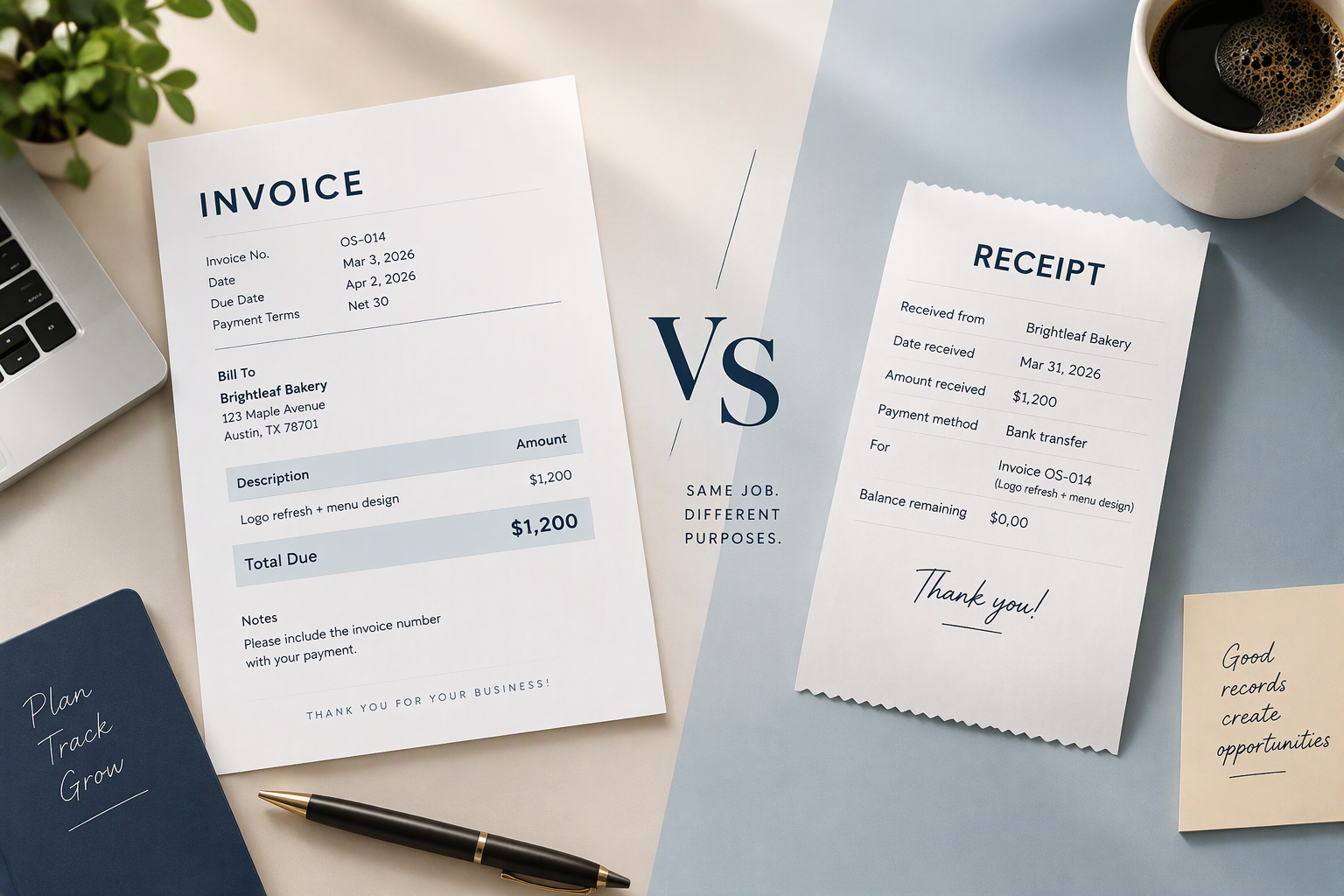
SAMPLE — FICTIONAL DOCUMENT
INVOICE OS-014
From: Ortiz Studio
To: Brightleaf Bakery
Invoice date: Mar 3, 2026
Payment terms: Net 30 (due Apr 2, 2026)
| Description | Amount |
|---|---|
| Logo refresh + menu design | $1,200 |
| Total due | $1,200 |
Pay by bank transfer or check. Please include the invoice number with your payment.
SAMPLE — FICTIONAL DOCUMENT. Not a real invoice.
What the parts do:
- Invoice number: a unique label, so a payment can be matched to this invoice later.
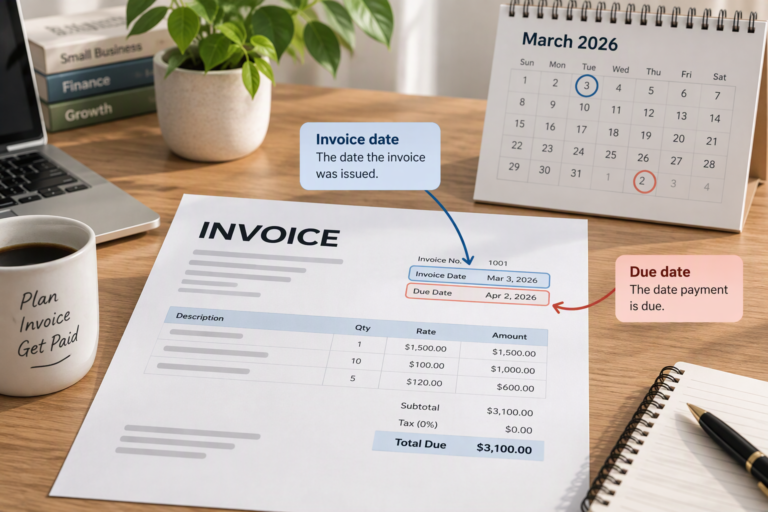
- Dates: the date the invoice was issued and the date payment is due.
- Payment terms: “Net 30” is commonly used in business as shorthand for “payment due within 30 days.” It is general commercial terminology, not a legal, tax, or universal rule. Businesses choose their own terms, so read the terms on the document itself.
- Description and amount: what the invoice covers and how much is being asked.
- Payment instructions: how the client can pay.
Step 2: The payment and the receipt
On Mar 31, Brightleaf Bakery pays the full amount by bank transfer. Maya then sends a receipt.
SAMPLE — FICTIONAL DOCUMENT
PAYMENT RECEIPT
Received from: Brightleaf Bakery
Received by: Ortiz Studio
Date received: Mar 31, 2026
Amount received: $1,200
Payment method: Bank transfer
For: Invoice OS-014 (Logo refresh + menu design)
Balance remaining: $0.00
SAMPLE — FICTIONAL DOCUMENT. Not a real receipt.
The receipt points back to the invoice number and shows the balance remaining. Those two details make it easy to see which invoice the payment settled and whether anything is still owed.
Step 3: The same invoice, from the other side
For Brightleaf Bakery, invoice OS-014 is a bill: a request to pay that arrived from a supplier. It is the same document. Only the person holding it has changed.
Maya also receives bills from suppliers. Here is one that is due on receipt:
SAMPLE — FICTIONAL DOCUMENT
BILL
From: Pixelfern Tools
To: Ortiz Studio
Bill date: Apr 1, 2026
For: Software subscription (monthly)
Amount due: $50
Terms: Due on receipt
SAMPLE — FICTIONAL DOCUMENT. Not a real bill.
The timeline
- Mar 3: Ortiz Studio sends invoice OS-014 to Brightleaf Bakery.
- Apr 2: the due date under the Net 30 terms.
- Mar 31: the payment arrives and the receipt goes out.
Invoice, receipt, and bill explained
What is an invoice?
An invoice is a document a seller sends to ask for payment for work done or goods supplied. It usually says who is asking, who is being asked, what the payment covers, how much, and by when. Formats vary from one business to the next, and some clients ask for particular details, such as a project or reference number. What is an invoice? explains each section.
An invoice is also a record of what you have asked to be paid. Keeping track of which invoices have been paid, and which have not, is a routine part of running a small business. See How to organize unpaid invoices for one simple way to do it.
What is a receipt?
A receipt confirms that a payment was received (what a receipt should include). Most people know receipts from everyday purchases: you pay at a store and the seller hands over a receipt.
In freelance and small-business work, practices differ. Some businesses send a separate receipt after each payment. Others mark the invoice “Paid” with the payment date, or send a short payment confirmation instead. Whether a separate receipt is needed depends on the business’s own practice and on what the client asks for.
When a payment covers only part of an invoice, a receipt is clearer if it shows the balance still owed.
What is a bill?
“Bill” has two common meanings, and context tells you which one is in play:
- An invoice, seen from the buyer’s side. The supplier calls it an invoice; the person who has to pay it calls it a bill.
- A simple request for payment. A utility bill is a familiar example: it shows what you owe and when it is due, without the detail of a typical invoice.
In everyday speech, “bill” and “invoice” are often used interchangeably, and some businesses use them slightly differently from others. There is no single dividing line, so look at what the document actually says: who issued it, what it covers, how much is due, and when.
Common mistakes
- Marking an invoice “Paid” before the money has arrived. Wait until the payment is actually in.
- Mixing up the dates. The invoice date, the due date, and the payment date are three different dates. Label each one clearly.
- Leaving off an invoice number. Without a number or reference, it is harder to match a payment to the invoice it settles.
- Giving a receipt for a partial payment without showing the balance. Both sides may lose track of what is still owed.
- Using “invoice,” “bill,” and “receipt” interchangeably in your own records. Pick one label for each kind of document and use it consistently.
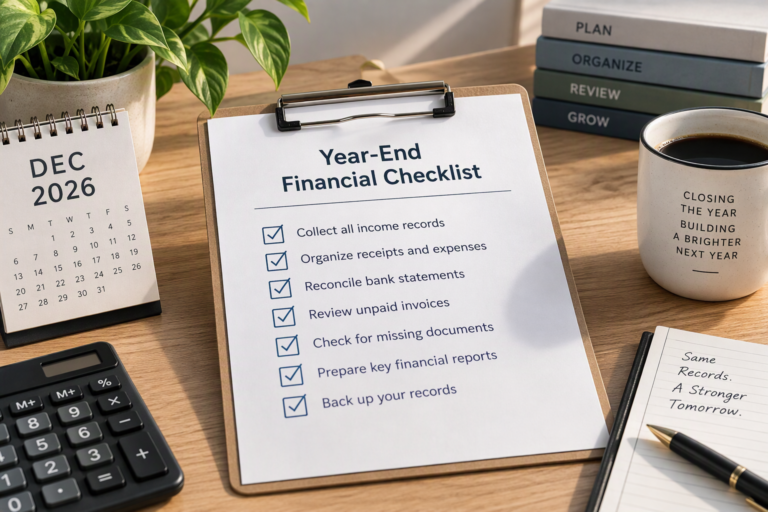
- Not keeping copies. If you cannot find the invoice, the payment, or the confirmation later, it is harder to reconstruct what happened.
Keeping the documents together
Our tip: Keep the invoice, payment record, and receipt together when available. Each document captures a different part of the transaction.
For general context, the IRS publishes recordkeeping guidance. On its page What kind of records should I keep, the IRS lists invoices, receipts, and paid bills among the supporting documents. It says these contain the information needed to record in a business’s books, and that they should be kept in an orderly fashion, for example by year and type of income or expense. IRS Publication 583 (12/2024) also lists receipt books and invoices among the documents that show gross receipts, meaning the income a business receives, and lists invoices among the documents for expenses.
This article does not cover which documents any particular business needs to keep or for how long. For questions about your own records, check IRS.gov or talk to a qualified professional.
What can vary
- Payment terms. “Due on receipt,” “Net 30,” deposits, and milestone payments are all used. Each business and client chooses.
- Receipts. A separate receipt, a “Paid” invoice, or an automatic payment confirmation: practice differs.
- Accounting. Whether an invoice is recorded when it is sent or only when it is paid depends on how the business keeps its books, which this article does not cover.
- Who is asking. What works for a client’s records may not be what a lender, an insurer, or a tax preparer asks for. Ask them what they need to see.
- Location. This guide is written for readers in the United States. Other countries may use these words and documents differently.
Your next step
Pick one recent job and gather three things: the invoice you sent, the record of the payment (for example, on your bank statement), and whatever confirmation you gave the client. For each, check that you can see:
- the date,
- the amount,
- an invoice number or other reference that links it to the others, and
- who is on each side.
If something is missing, note what you would add to your invoice or receipt next time. Then keep the three together, as suggested above.
Frequently asked questions
Is an invoice the same as a receipt?
No. An invoice asks for a payment that has not been made yet. A receipt confirms a payment that has been made.
Can an invoice replace a receipt?
Sometimes an invoice marked “Paid,” with the payment date, does the job a receipt would do. Sometimes it does not. It depends on who needs the document and why.
Can a receipt be used as an invoice?
They do different jobs. A receipt looks back at a payment already made; an invoice asks for a payment still to come. Whether one can stand in for the other depends on who needs the document, so ask them.
Which comes first, an invoice or a receipt?
Normally the invoice, then the payment, then the receipt. In an everyday retail purchase, you pay on the spot and receive a receipt with no separate invoice.
Is a bill the same as an invoice?
Often it is the same document seen from the buyer’s side. Some businesses also use “bill” for a simple request for payment. Look at the details on the document itself.
Related reading
- What is an invoice? Every section explained
- What is a receipt and what should it include?
- How to organize unpaid invoices
- Invoice date vs due date
Sources
- IRS, What kind of records should I keep. Page shows “Last Reviewed or Updated: 03-Aug-2026.” Consulted November 17, 2026. Used for: the list of supporting documents (including invoices, receipts, and paid bills), the fact that they contain the information needed to record in the books, and the suggestion to keep them orderly, with the “year and type” example.
- IRS, Publication 583, Starting a Business and Keeping Records. Revised December 2024. Consulted November 17, 2026. Used for: receipt books and invoices as documents that show gross receipts, the description of gross receipts, and invoices as documents for expenses.
The explanations of invoices, receipts, and bills, the tip above, and all sample documents are the editorial team’s own and are not drawn from these sources.